01 / UAV design
ZITIN Disaster
Response UAV.
A vehicle concept shaped around a practical problem: getting first-aid supplies and a camera view to places where damaged routes limit ground access.
Project outcome
A mission-driven concept.
A prototype to build on.
The project advanced to Conrad Challenge Round 2 and received Conrad Innovator recognition. Our development work produced 3D models and, after the original competition submission, a physical prototype.
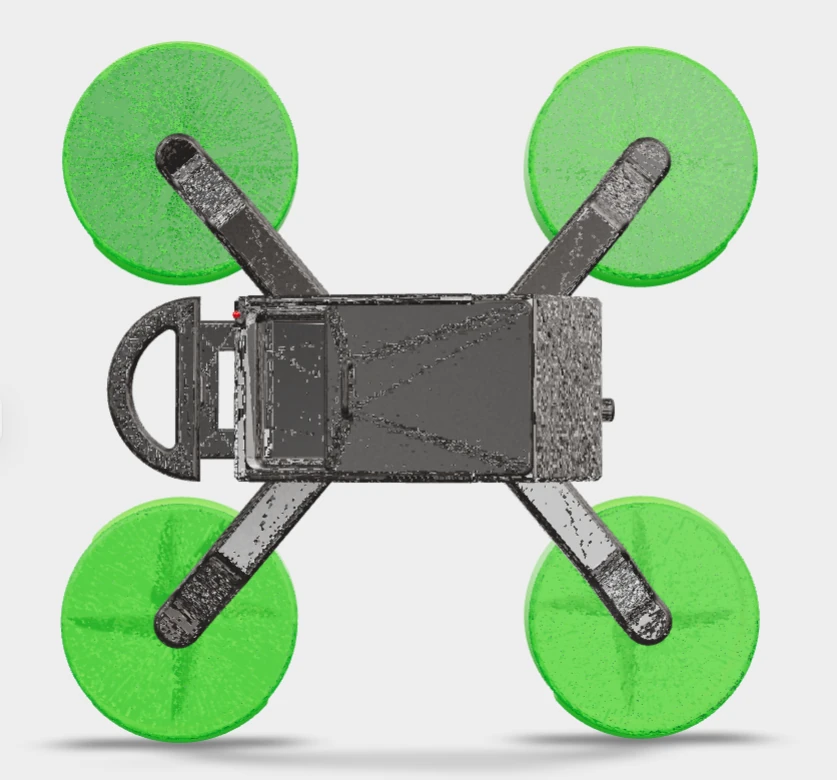 01 / Upper view
What I contributed.
I led the team, researched drone designs and materials, and disassembled and tested existing drones.
I created 3D models, helped arrange the medical hatch and separate tool attachment, and contributed to a physical prototype after the competition submission. I later drafted the technical report to bring the concept, design decisions, and proposed verification work together.
The mission shaped the layout.
The proposed mission combined visual assessment with small-supply delivery. A camera, a medical kit, and scenario-specific equipment all compete for space and add mass. That made the payload arrangement part of the aircraft design from the beginning.
We explored enclosed medical storage and a separate external attachment because they serve different needs: keeping supplies contained and allowing the tool or sensor payload to change.
Forward camera
Provide visual context for responders.
Rear medical hatch
Contain first-aid materials within the proposed airframe.
External tool clamp
Accommodate scenario-specific tools or sensors.
Controls and communications
Coordinate the proposed aircraft and information link.
These describe the proposed system architecture. The supplied CAD views represent the team model.
Packaging the mission.
Two payload functions needed different interfaces.
The proposed rear hatch and external clamp separated protected medical storage from changeable equipment. That made the design discussion more specific: what belongs inside the airframe, what attaches outside it, and how each arrangement affects the rest of the vehicle.
| Proposed feature | Reason for the layout | Design question |
|---|---|---|
| Enclosed medical hatch | Keep first-aid materials together inside the vehicle. | Kit volume, access, closure retention, and added mass. |
| Separate external clamp | Change a tool or sensor without redesigning the medical compartment. | Attachment loads, balance, and a defined release procedure. |
| Forward camera | Give responders a view before or during supply delivery. | Field of view, power demand, image quality, and communication range. |
Swipe or scroll horizontally to see every column.
This table describes the proposed architecture and its open design questions. It does not establish a tested payload capacity.
Materials need a design basis.
The original brief proposed titanium for the body and polypropylene for the wings, alongside an interest in recycled or recyclable construction. These were starting proposals for the concept.
Aircraft structure
Titanium proposal
The follow-on selection would need to connect material choice to actual loads, wall thickness, fabrication, and a mass budget.
Wing material
Polypropylene proposal
Stiffness, durability, repairability, and verified recycled content would need to be compared for the intended geometry.
What matters is the completed part: its mass, structural behavior, manufacturing route, and service life. A material name alone does not establish a lightweight or lower-impact design.
How the work developed.
Research the need
Study disaster-response access needs and existing drone configurations.
Study existing hardware
Disassemble and test existing drones to inform the concept.
Develop the layout
Produce 3D models and consider the medical hatch and separate tool attachment.
Continue the build
Contribute to a physical prototype after the competition submission and later document the work.
What the project delivered.
3D models and a configured aircraft concept
The team brought camera placement, medical storage, a tool attachment, and the aircraft configuration into one design discussion. Four supplied CAD views can be inspected above.
A physical prototype after submission
I contributed to the prototype work that followed the competition entry, alongside the earlier teardown and testing of existing drones.
A technical record of the design
I drafted the later report to explain the concept, distinguish completed activities from proposed capabilities, and define a practical verification sequence.
The competition outcome and prototype development are the recorded results. Payload mass, endurance, delivery accuracy, and response-time improvement remain to be measured.
What I would verify next.
A useful payload concept needs measurable limits.
The next step I would prioritize is an as-built prototype record, followed by a controlled verification sequence. These are proposed next tests.
| Design question | What I would check |
|---|---|
| What can the aircraft carry? | Record the empty and loaded mass and the dimensions of the intended medical kit. |
| Will the payload stay secured? | Check the medical hatch closure and external-clamp retention under controlled conditions. |
| Can the operator obtain useful information? | Bench-test the camera, controls, and communications before flight testing. |
| How does a representative payload affect operation? | Conduct supervised flight tests with progressively representative loads and compare results with defined mission requirements. |
Project records: ZITIN technical report, pp. 3–7 and 9; team Shapr3D model and supplied CAD views. No measured payload, endurance, or flight-performance figures are presented here.